
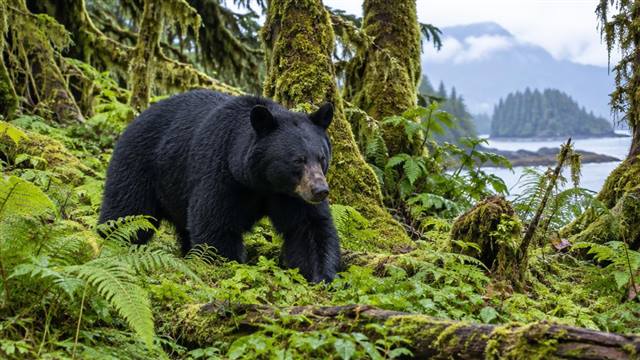
Be slow to move quickly through Coastal bear country, for the varied habitats of rainforest, muskeg, salmon streams and tidal shorelines all impart vastly different characteristics to each. Long periods of time are spent glassing in order to render those long hours productive. Same rules apply to safeguarding the cubs, other wildlife and the environment. Take a few minutes before heading out to learn what you are looking for and what weather will mask it. None of that is worth your hunting.
Read the Landscape in Layers
The Alaska coastal rainforest is not a uniform habitat. Mature spruce and hemlock can be good traveling routes through cover. Open sightlines such as windthrows, avalanche chutes and edge can be good areas for bears to feed or travel through. These areas can be very difficult to judge size and distance due to dense vegetation.
Similarly, muskeg can give good glassing over areas where bears are active. Low-lying plants, small pools of water and scattered dead trees are often highlighted against the open area to give good visibility of bears traveling through the area. Note, however, that hummocks, deep shadows and folds in the ground can obscure additional bears, or obscure the shot and angle to a bear.
Likewise, shoreline areas can be composed of several different habitats which a bear may travel in search of food. Look for areas where the forest gives way to the beach or where a bear's path of travel follows the edge of a creek or estuary. Look for areas of higher vegetation such as spruce or hemlock which may provide cover for a bear's travel down to the beach.
Follow Food, Cover and Movement
Third, apply these key concepts by paying attention to the location's food, cover and movement.
Again, note that even in areas with a lot of sign of bears visiting a salmon stream, that does not necessarily mean there are any bears currently in the area. Also, remember that salmon runs are highly variable and often lower than in past years, and that bears in coastal areas are frequently not exclusively salmon-eating animals. More often than not, other foods such as foliage, carrion, and fruits and berries in various stages of ripeness will comprise the majority of a bear's diet in coastal habitats.
Remember, having animals move through old tracks, overturned stones, torn up vegetation, digging and their scat does not mean they are currently in the area. It simply means they have recently traveled through the area and it is worth looking at recently. Determine if the signs appear to be sharp and undisturbed. Compare the signs to the current food supply. See if high winds, recent rains or a rise in water could have washed away signs left by the bear recently.
Let the Season Change the Plan
Alaska's coastal regions can change in terms of hunting quality from week to week and even day to day. Early season foliage of green spruce and hemlock can mask bear sign while berry production creates new elevations to hunt. Later in the season when all food sources have come into production bears can concentrate on lower lying areas. Wet weather can renew sign while making it harder to spot said sign. Low-lying cloud can makes hills side appear to shrink in size from the water and strong winds can greatly affect an animal's travel and make for very poor stalking.
As the day goes on, conditions that allowed a long glassing time at a particular location in good weather will not have the same merit in poor weather. On the other hand, short periods of good weather can reveal highly productive locations that were not visible previously. Make sure that you can identify the bear, know its surroundings and have a safe shot from wherever it is. If you cannot do this then the conditions have not yet reached a suitable standard.
Make Glassing Patient and Exact
When glassing for wildlife look for edges, such as the junction of different habitats, stream courses, avalanche paths, the edges of beaches and shoreline. View these areas slowly and in detail and revisit them frequently as the animal may move within minutes. While watching for movement, also look for changes in the animal's posture, as it will relaxed while foraging.
Divide your field of view up into sections of the land, and use landmarks such as tree tops, ridge lines, etc. to aid in your reference points. Keep a note of where you last left off, and pass this information on to other glassers. Refer to the photo for examples of 'vague' descriptions that will only lose you time and lead to more uncertainty.
Because the inexperienced glasser experiences a lot of uncertainty about the animals he sees, and changes his mind about their size, it would be wise to use these signs as a warning to change direction or to stop looking for that particular animal.
Set the Ethical Shot Before It Appears
Wait until you have confirmed the age, sex, species of the bear and have a definite shot at it. This means working to determine if there are any cubs present with the female, checking out the background and considering how the bear will travel if it is shot and wounded. Look for extremely steep terrain, impenetrable thick stands of trees, fast flowing water, and people or other boats in the vicinity.
Don't consider partial exposure of the animal to be a reason to take the shot. Also, don't use a less than optimal shot angle or be tempted to shoot as the animal disappears behind a screen of trees or other objects. If you cannot obtain a positive identification of the bear's size, sex, or species, do not take the shot. Pass on for another day when you have a better view.
Always follow the instructions of your licensed guide or other qualified member of your hunting party. Make sure to use your equipment in the exact manner in which it was intended. Before heading out on a hunt go over with your party the details of communication, weather, extraction, and what you will do in the case of wounding an animal or not being able to retrieve it.
Keep Wildlife Stewardship in the Plan
Finally, have respect for all wildlife in the area. Other species such as marine mammals, birds like eagles, and even deer and other game species using the same areas for food or shelter could be easily disturbed by a hunter's approach and shot. Food sources for bears like coastal greenery, berry patches, salmon streams and the like should not be disturbed, and left in as good condition as was found.
Don't be fooled by signs of a sow with cubs, a non-target species moving into the area, unsteady surfaces or a poor boat location for retrieving harvested animals. These are real warnings and should be heeded and other wildlife and their habitats shown the respect that is shown to bears during hunting seasons.
Finally, be sure to check for changes to coastal Alaska hunting seasons, bag limits, salvage regulations, licenses, tags, and transportation of harvested mammals to and from the field. Information on current regulations can be found at the Alaska Department of Fish and Game website as well as on federal lands and refuges where additional regulations may apply. It's wise to confirm all information with the appropriate state or federal office as well as with your guide prior to your trip. Things change!
It's time to reorient our perceptions about coastal country. A successful hunt is not determined by persistence in marginal habitat. Such hunting serves to protect the bear, the rest of wildlife, and our traveling to enjoy great country.